Terrestrial habitat

Terrestrial habitat in Puget Sound varies greatly, from alpine and subalpine meadows and evergreen forests to valleys, floodplains, and prairie. However, these ecosystems are not clearly divided but blend smoothly into each other, linked by rivers and streams and the overlapping ranges of various species, determined by their tolerance of various environmental conditions. Various approaches exist for categorizing habitat types. Franklin and Dyrness developed a system in 1973 using dominant tree species as distinguishing features. In the Northwest, Sitka spruce dominates the lower elevations, moving towards Western hemlock and Douglas fir farther from sea level. Silver fir is more prevalent in the middle range, and mountain hemlock at higher elevations. Jones (1936) established the four Merriam’s Life Zones: Humid Transition, Canadian, Hudson, and Arctic-Alpine, which are defined by vegetation patterns, precipitation, and elevation.

Sources:

Kruckeberg, Arthur. A Natural History of Puget Sound Country.1991. University of Washington Press, Seattle, WA.

Overview

Freshwater habitat in the Puget Sound region consists of rivers, marshes, streams, lakes and ponds that do not have any saltwater input. Many species depend on these freshwater resources, including salmon, salamanders, frogs, and beavers.

Freshwater habitat in King County. Photo by Jeff Rice. All rights reserved.

Related Articles

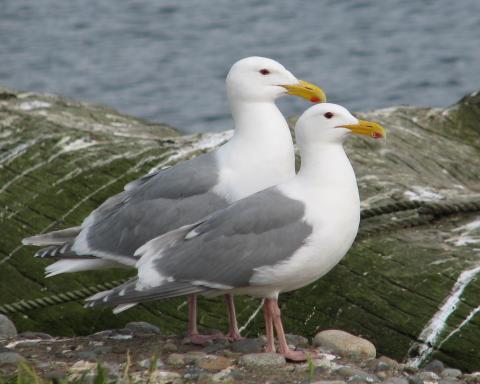
A 2017 paper in the journal Northwestern Naturalist looks at distribution patterns for Glaucous-winged Gulls across associated habitats in the Salish Sea.  

In recent decades, hundreds of millions of dollars have been spent to restore habitat for Puget Sound salmon. In this article, we look at how scientists are gauging their progress. Are environmental conditions improving or getting worse? The answer may depend on where you look and who you ask.

The state of Washington estimates that the Puget Sound area will grow by more than 1.5 million residents within the next two decades. That is expected to have profound effects on the environment as more and more people move to undeveloped areas. The race is on to protect this critical rural habitat, but planners say what happens in the cities may be just as important.

The Puget Sound Ecosystem Monitoring Program (PSEMP) is an independent program established by state and federal statute to monitor environmental conditions in Puget Sound. 

A new approach to flood control is taking hold across Puget Sound. Rivers, scientists say, can be contained by setting them free. Conservationists hope this is good news for salmon recovery.

Throughout the Puget Sound region, impacted and poorly managed agriculture has been repeatedly advanced as a leading contributor to surface and ground water pollution, particularly during the winter months. A study conducted from 2010 - 2015 aimed to develop an Application Risk Management (ARM) System to minimize pollution from manure in Whatcom County.