Nearshore habitat

The nearshore habitat of Puget Sound is usually defined as the area from the bluffs that line the shore to the area where water becomes too deep for light to penetrate and allow plants to grow, measured relative to mean lower low water (MLLW). It includes marine habitat and estuarine habitat, but stops at the farthest reach of the tide into an estuary, or the point where saltwater no longer mixes with fresh. Within Puget Sound’s nearshore are many varied habitat types, including rocky and sandy beaches, mudflats, salt marshes, kelp and eelgrass beds, and lagoons.

Sources:

Puget Sound Nearshore Ecosystem Restoration Project: http://www.pugetsoundnearshore.org/technical_reports.html.

Overview

The Puget Sound Nearshore Ecosystem Restoration Project (PSNERP) works to assess the health of Puget Sound nearshore environments and provides strategies for their protection and restoration. 

PSNERP logo

Related Articles

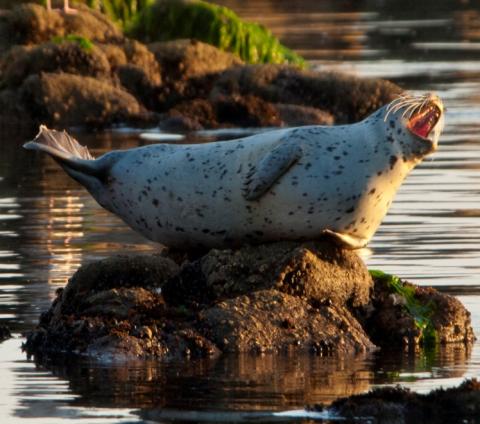
Harbor seals (Phoca vitulina) are the most commonly seen marine mammals in the Salish Sea and can be found throughout the region year round. They have been intensively studied within the Salish Sea and this species profile provides an overview of what is known about them. It was produced for the Encyclopedia of Puget Sound by the SeaDoc Society. 

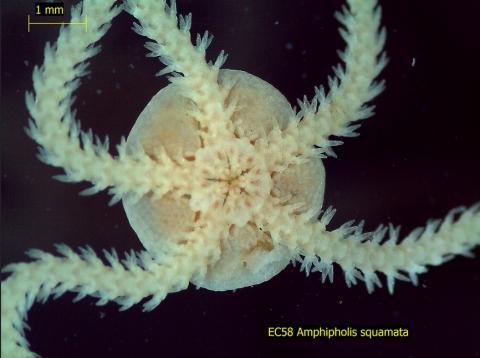
A list of over 1800 benthic infaunal invertebrates is now available on the Encyclopedia of Puget Sound. The list was prepared as part of the Washington State Department of Ecology’s Marine Sediment Monitoring Program (MSMP).  This program, initiated in 1989, is one component of the Puget Sound Ecosystem Monitoring Program, a collaborative effort dedicated to monitoring environmental conditions in Puget Sound. 

Benthic infaunal invertebrates, often referred to as benthos, are tiny animals, including worms, clams, snails, shrimp, crabs, brittle stars, and many others, that live in the sand and mud at the bottom of Puget Sound.  Benthos are an essential link in

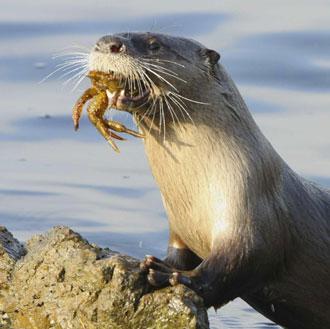
A 2014 paper in the journal Aquatic Mammals examines coastal river otter predation on rockfish at three islands in the Salish Sea.

Approximately every two years, the SeaDoc Society prepares a list of species of concern within the Salish Sea ecosystem. The following paper found 119 species at risk and was presented as part of the proceedings of the 2014 Salish Sea Ecosystem Conference, April 30 – May 2, 2014, Seattle, Washington. 

Several research groups in the region are investigating biological markers and/or impacts of Contaminant of Emerging Concern (CEC) exposure in different organisms.  An abstract describing each study is included below.  Also included are links or contact details for further information about each project.

Several studies have been performed to determine the occurrence of selected Contaminants of Emerging Concern (CECs) in the environment.